Sale!

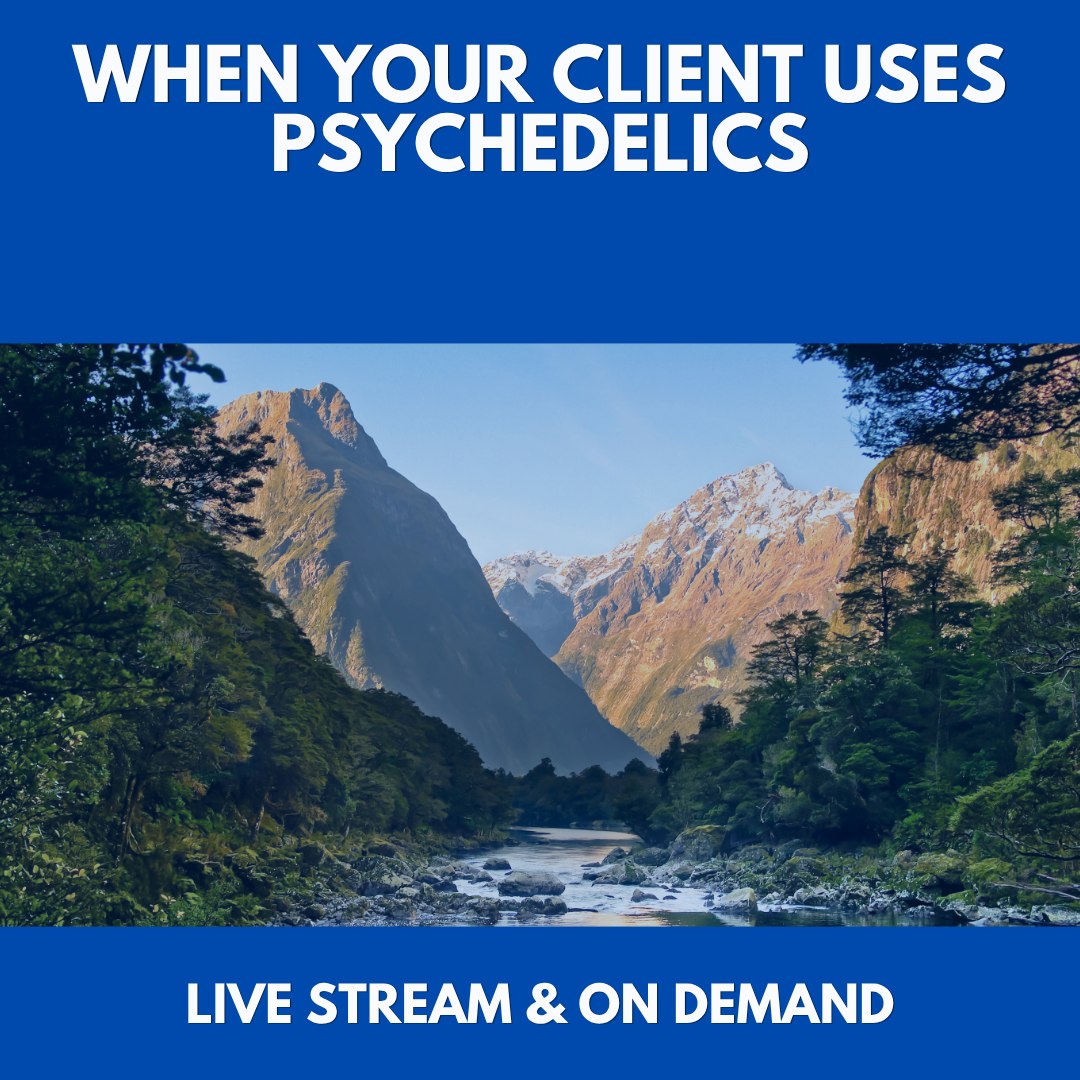
When Your Client Uses Psychedelics: Harm Reduction and Integration for the Non-Specialist Clinician

Original price was: $169.00.Current price is: $126.75.

6 Hours  |   Pre-approved for CEUs

Presenter
Peter Addy, Ph.D.
Date
November 23, 2026
somdn_product_page
Virtual Registration Only

This page is for virtual attendance only. Your registration includes access online via live webinar and/or on-demand recording.

To attend this event in person, please register through our In-Person Events website.

Register to Attend
In-Person
In-Person Conference Registration

LIVE STREAM: November 23, 2026 from  8:30am – 4:00pm PST (Vancouver, BC) Please adjust your start time according to your specific time zone. 

ON-DEMAND: Recorded footage & course content (certificate, videos, quiz) will be available until January 4, 2027. Please allow 1-3 business days for footage to be processed. Extensions cannot be granted under any circumstances.


Most clinicians already see clients who use psychedelics, sometimes at a festival, sometimes at a retreat, sometimes alone at home, usually outside any clinical structure. Most clients do not disclose it. When they do, the clinician is often the least prepared person in the room. This six-hour webinar is for clinicians in that position. It covers what these compounds do, the acute risks, what psychedelic-assisted psychotherapy is, what the trials do and do not show, and where clients are actually obtaining psychedelics in Canada and the US. The focus is practical: what happens to a disclosure once it is documented, how to approach consent and documentation in a way that protects both the client and the record, how integration work looks when there was no clinical container to begin with, and why autistic, ADHD, and disabled clients require additional foresight. You will leave able to respond to a disclosure with something better than improvisation, and knowing where the boundaries of your own competence begin and end.

  • Describe the pharmacology, subjective effects, and acute risk profile of classic and atypical psychedelics.
  • Distinguish psychedelic-assisted psychotherapy from psychedelic harm reduction and integration.
  • Construct documentation and informed consent for a client disclosing or planning psychedelic use.
  • Apply integration approaches to a client’s account of a psychedelic experience.
  • Explain how preparation, the psychedelic experience itself, and integration may differ for autistic, ADHD, and disabled clients, and where clinicians misread them.
  1. Foundations (180 min)

1.1. Welcome, orientation, and what this course is not (10 min)

1.2. What clinicians are actually encountering (20 min)

1.3. Pharmacology and subjective effects (40 min)

1.4. Acute risk and adverse events (30 min)

Break

1.5. Psychedelic-assisted psychotherapy (40 min)

1.6. The access landscape (40 min)

  1. Ethics, disclosure, and documentation (60 min)

2.1. Detection risk versus disclosure risk (20 min)

2.2. Documentation, consent, and your own scope of practice (40 min)

Break

  1. Integration in practice (30 min)

3.1. Integration when there was no clinical container (15 min)

3.2. Approaches, and their limits (15 min)

  1. Culture, context, and who gets misread (90 min)

4.1. Ceremonial use, Indigenous sovereignty, and Canadian law (25 min)

4.2. Reading the report: neurodivergence, sensory difference, and misinterpretation (25 min)

4.3. Adapting preparation and integration (25 min)

4.4. The clinician’s own location, and close (15 min)

Peter H. Addy, Ph.D. earned his PhD in clinical psychology studying transcendence, wholeness, and transformation at the Institute of Transpersonal Psychology. As faculty at Yale University, he conducted research with atypical psychedelics including salvinorin A, THC, and ketamine. He has written and spoken about psychedelic science for over a decade, co-founded the Yale Psychedelic Science Group, and documented traditional healing and religious practices that incorporate psychedelic medicine in Mexico. He currently maintains a private practice in Portland, Oregon where he offers therapy, clinical supervision, and professional trainings.

Clinical Professionals: All mental health professionals including, but not limited to Clinical Counsellors, Psychologists, Psychotherapists, Social Workers, Nurses, Occupational Therapists, Hospice and Palliative Care Workers, School Counsellors, Youth Workers, Mental Health Workers, Addiction Specialists, Marital & Family Therapists, Speech Language Pathologists, Vocational Rehabilitation Consultants and all professionals looking to enhance their therapeutic skills.

Shopping Cart
Scroll to Top