Free 1-Hour On-Demand Course
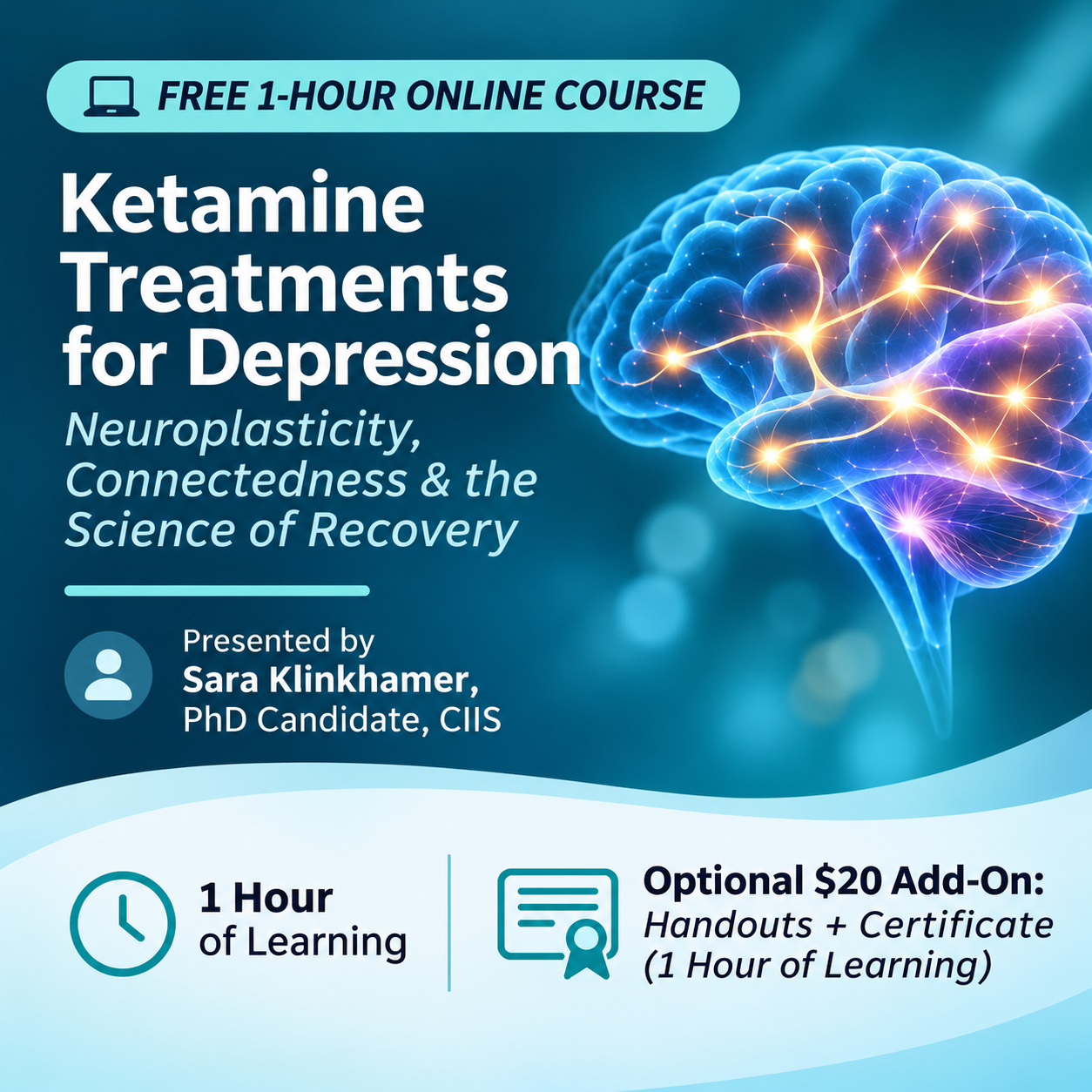
Ketamine Treatments for Depression
Neuroplasticity, Connectedness, and a Disconnectedness Theory of Depression
Presented by Sara Klinkhamer, MA, Ph.D. Candidate, RCC
Choose Your Course Access
This 1-hour online course is available to watch completely free. Participants who would like downloadable presentation handouts and a certificate of completion can select the $20 CAD option.
Please select only ONE of the two registration options.
OPTION 1: FREE – Video Access Only
$0 CAD
- Full 1-hour on-demand course recording
- Watch online at your convenience
- No presentation handouts included
- No certificate of completion included
OPTION 2: Video + Handouts + Certificate
$20 CAD
- Full 1-hour on-demand course recording
- Downloadable presentation handouts
- Certificate of completion documenting 1 hour of learning
- Certificate available after completing all course requirements
How to Register: Select either the FREE or $20 option in the registration area and click “Add to Cart.” You only need to select one option.
Certificate Information: Certificates document completion of 1 hour of learning. Acceptance toward professional continuing education requirements is determined by your individual regulatory body or organization.
Course Overview
How might ketamine change the way we understand and treat depression? This one-hour educational presentation explores the emerging science of ketamine treatments, the role of neuroplasticity, and the possibility that meaningful recovery involves more than symptom reduction.
Beginning with ketamine’s rapid antidepressant effects, Sara Klinkhamer examines how changes in neural flexibility may create opportunities for psychological learning and change. The course compares biomedical approaches with ketamine-assisted psychotherapy and introduces a Disconnectedness Theory of Depression, considering how connection to self, others, the world, meaning, and the future may inform treatment and recovery.
Participants will explore how ketamine’s effects on glutamate signalling and neural plasticity may create a temporary opportunity for psychological change. The presentation considers how therapeutic relationships, meaningful experiences, and post-treatment integration may contribute to recovery.
The course also examines the current research on ketamine-assisted psychotherapy, highlighting both promising findings and important limitations. Clinical safety, ethical considerations, and the need for further research are discussed throughout.
What You’ll Explore
- Why ketamine has changed the conversation around treatment-resistant depression.
- How glutamate signalling and neuroplasticity may contribute to antidepressant effects.
- The differences between biomedical ketamine treatment, psychological integration, and ketamine-assisted psychotherapy.
- Why a temporary window of increased flexibility is an opportunity for change rather than a cure in itself.
- How depression may be understood through disconnection from self, relationships, community, meaning, and future possibilities.
- What current evidence suggests about connectedness, psychotherapy, and post-treatment integration.
- Clinical considerations, research limitations, and important safety cautions.
Learning Objectives
By the end of this course, participants will be able to:
- Describe key concepts related to ketamine’s antidepressant effects and neuroplasticity.
- Distinguish between biomedical and psychotherapy-integrated models of ketamine treatment.
- Explain the proposed relationship between depression, psychological rigidity, and disconnectedness.
- Identify potential clinical implications and limitations of connectedness-focused treatment models.
Who Should Attend?
This introductory educational course may be of interest to counsellors, psychologists, psychotherapists, social workers, mental health and addiction professionals, students, and other healthcare practitioners interested in emerging approaches to depression treatment.
About the Presenter
Sara Klinkhamer, MA, Ph.D. Candidate, RCC, presents an exploration of ketamine treatments for depression through the lenses of neuroplasticity, psychotherapy, and connectedness.
The session draws on clinical research and emerging theoretical models to consider how biological change and lived experience may intersect in recovery.
Educational Disclaimer:
This course is intended for professional education and general information. It does not provide individual medical advice, treatment recommendations, or training to administer ketamine. Evidence for some proposed mechanisms and psychotherapy-integrated approaches is still emerging. Clinical treatment decisions require appropriately qualified professionals and applicable safety protocols.