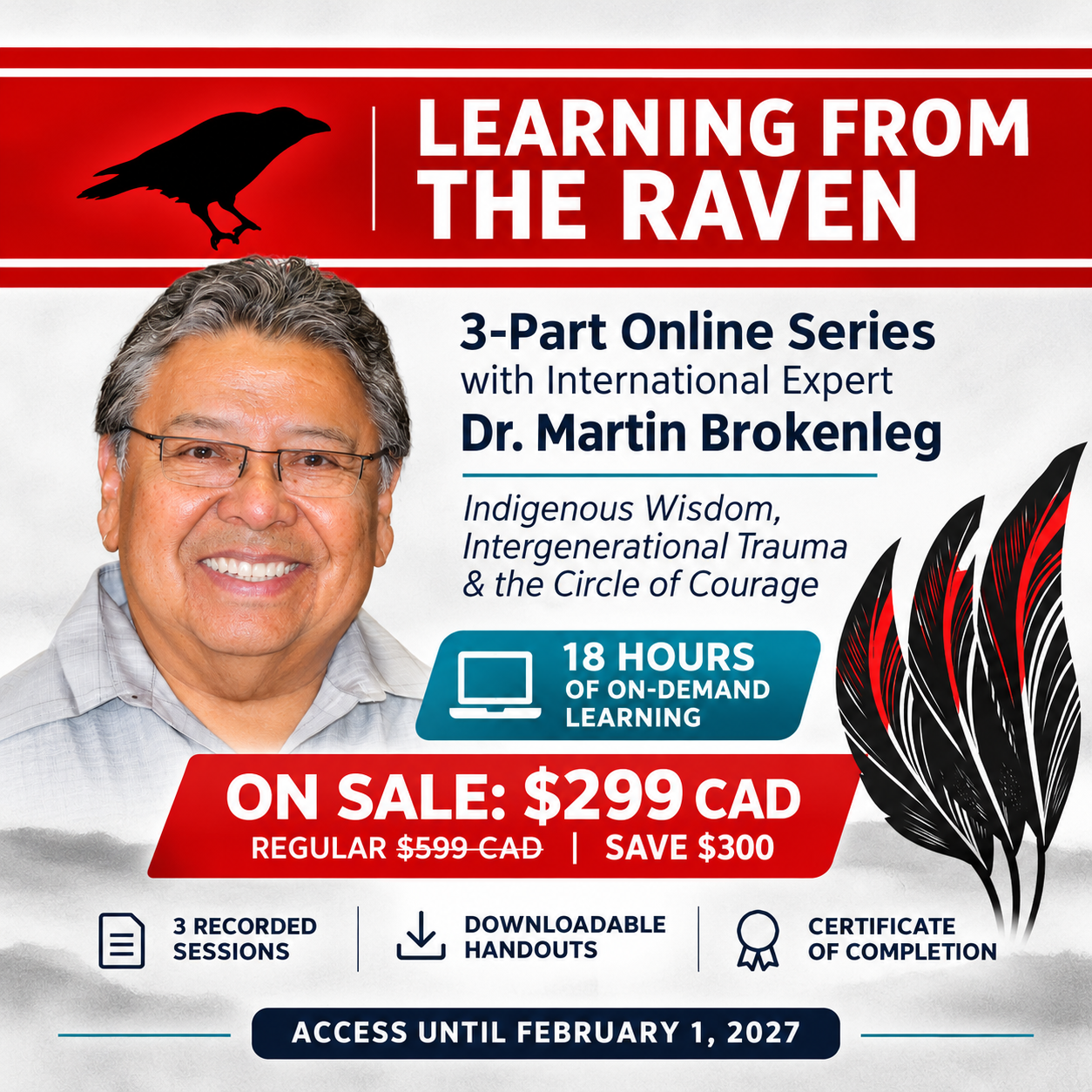
Reclaiming Indigenous Wisdom: Intergenerational Trauma, Resilience & the Circle of Courage
Presented by Martin Brokenleg, Ed.D.
Explore Indigenous perspectives on healing, resilience, identity, and belonging through this comprehensive three-part recorded series. Learn how historical and intergenerational trauma impacts children, youth, families, and communities, and discover practical approaches to fostering resilience, strengthening relationships, and supporting positive development.
About This Course
Join internationally recognized educator and author Dr. Martin Brokenleg, co-author of Reclaiming Youth at Risk: Our Hope for the Future and co-developer of the Circle of Courage model, for an engaging and thought-provoking professional development series.
Drawing on Indigenous knowledge, cultural traditions, research, and extensive professional experience, Dr. Brokenleg examines the lasting effects of historical and intergenerational trauma and the essential role of culture, connection, and belonging in promoting healing and resilience.
Across three interconnected sessions, participants will explore Indigenous philosophies, trauma-informed approaches, and practical strategies for supporting the social, emotional, and developmental needs of children, adolescents, and families.
The series progresses from foundational cultural understanding to resilience-building strategies and the practical application of the Circle of Courage model in educational, clinical, and community settings.
This is a previously recorded professional development series. All three sessions are included with registration and can be completed at your own pace during the access period.
Course at a Glance
- Presenter: Martin Brokenleg, Ed.D.
- Format: Previously recorded, fully on-demand
- Total Duration: 18 hours
- Sessions: Three 6-hour recorded workshops
- Access: Available until February 1, 2027
- Materials: Downloadable PDF handouts
- Assessment: Short course quizzes
- Certificate: Certificate of completion upon meeting course requirements
What’s Covered in the Series
Indigenous Culture, Identity & Intergenerational Trauma
The first session establishes a foundation for understanding traditional Indigenous cultures, philosophies, values, and ways of life.
Dr. Brokenleg examines how historical social and cultural disruptions have affected individuals, families, and communities, particularly through the loss of cultural knowledge, identity, spiritual connection, and intergenerational teachings.
Participants will explore how these disruptions continue to influence emotional well-being, family relationships, and community health across generations.
Special attention is given to understanding why interventions that focus exclusively on immediate behaviours or symptoms may fail to address the deeper impacts of intergenerational trauma.
Key topics include:
- Traditional Indigenous philosophies, values, and cultural perspectives
- The historical disruption of cultural identity and community connections
- Understanding the transmission and impacts of intergenerational trauma
- The relationship between culture, spirituality, identity, and emotional well-being
- Recognizing the limitations of symptom-focused interventions
- Indigenous perspectives and approaches to living well in contemporary society
Understanding Trauma & Building Resilience
Building on the cultural foundations established in Part One, this session explores the social, emotional, and cognitive effects of intergenerational trauma and the importance of resilience in recovery and well-being.
Dr. Brokenleg examines how trauma can influence development, relationships, learning, and behaviour, while highlighting the importance of culturally responsive, trauma-informed support.
Drawing on Indigenous cultural knowledge, research, and practical experience, he introduces resilience-building approaches that can be applied across diverse populations and professional settings.
Participants will develop a deeper understanding of how to move beyond short-term interventions and create environments that promote meaningful, lasting support.
Key topics include:
- Recognizing the effects of historical and intergenerational trauma
- Understanding the social, emotional, and cognitive impacts of trauma
- Applying trauma-informed principles in professional practice
- Identifying protective factors that strengthen resilience
- Supporting healing through relationships, connection, and cultural understanding
- Developing practical strategies for individuals, families, and communities
Social-Emotional Learning & the Circle of Courage
The final session focuses on the practical application of the Circle of Courage model to support the healthy social and emotional development of children and adolescents.
Developed from traditional Indigenous perspectives on raising and supporting young people, the Circle of Courage identifies four essential developmental needs: belonging, mastery, independence, and generosity.
Dr. Brokenleg explores how these principles can guide educators, parents, counsellors, and helping professionals in creating environments where young people feel connected, capable, valued, and empowered.
Participants will learn strategies for strengthening relationships, supporting positive behaviour, improving classroom environments, and encouraging resilience at school and at home.
Key topics include:
- Understanding the four principles of the Circle of Courage
- Supporting belonging, mastery, independence, and generosity
- Creating supportive environments for children and adolescents
- Integrating social-emotional learning into everyday practice
- Practical classroom management and parenting approaches
- Strengthening relationships and promoting positive youth development
What You Will Learn
By the end of this series, participants will be better equipped to:
- Explain how historical and intergenerational trauma can affect identity, relationships, emotional well-being, and development.
- Recognize the importance of Indigenous cultural knowledge and perspectives in supporting healing and resilience.
- Identify limitations of interventions that focus solely on behaviours or immediate symptoms.
- Apply trauma-informed and culturally responsive principles when supporting children, youth, and families.
- Understand the role of belonging, connection, and positive relationships in strengthening resilience.
- Describe the four principles of the Circle of Courage and their relevance to healthy development.
- Identify practical strategies for creating supportive learning, family, and community environments.
- Incorporate resilience-building approaches into educational, counselling, mental health, and community-based practice.
Who Should Attend?
This professional development series is designed for individuals who work with children, adolescents, families, and communities, including:
- Teachers, educational assistants, and school administrators
- School counsellors and student support professionals
- Psychologists, therapists, and mental health professionals
- Social workers and family support practitioners
- Indigenous education and community support professionals
- Child and youth care workers
- Community service providers
- Parents, caregivers, and others interested in trauma-informed approaches and positive youth development
The concepts and strategies presented are relevant across a range of educational, clinical, family, and community settings.
What’s Included with Registration
- 18 Hours of Recorded Instruction
Access to all three 6-hour sessions featuring Dr. Martin Brokenleg, including the originally recorded lecture and discussion content.
- Flexible On-Demand Learning
Watch the recordings at your own pace, pause when needed, and revisit the content throughout your access period.
- Downloadable Course Handouts
PDF course materials to support your learning and professional reference.
- Certificate of Completion
Receive a digital certificate after completing the required lessons and successfully passing the course quizzes.
- Access Until February 1, 2027
All course recordings and online materials remain available through the stated access period.
About the Presenter
Martin Brokenleg, Ed.D.
Dr. Martin Brokenleg is an internationally recognized educator, author, and speaker whose work focuses on Indigenous perspectives, resilience, positive youth development, and the well-being of children and adolescents.
He is co-author of Reclaiming Youth at Risk: Our Hope for the Future and co-developer of the widely recognized Circle of Courage model, which emphasizes the importance of belonging, mastery, independence, and generosity in the healthy development of young people.
Through his teaching and presentations, Dr. Brokenleg brings together Indigenous knowledge, cultural traditions, and contemporary approaches to education and human development. His work provides educators, mental health professionals, and community practitioners with a framework for understanding trauma, strengthening resilience, and creating environments in which children and youth can thrive.
Important Course Access Information
This is a previously recorded course, not a live event. Registration provides online access to the complete three-part series.
Course access is available until February 1, 2027. Participants are responsible for completing all required lessons and quizzes before access expires.
Recordings are available for online viewing only and cannot be downloaded. Course handouts are provided digitally.
Certificates are issued upon successful completion of all course requirements. Continuing education eligibility and acceptance are subject to the requirements of your professional association or regulatory body.
Registration is for one participant only. Account sharing and sharing of course access are not permitted.
$599 CAD + Applicable Taxes
One registration includes all three sessions and 18 hours of recorded professional development.
Individual registration only. All three sessions are included in this product.
Before registering: Please review the course description, learning objectives, format, and access information to ensure this training meets your professional development needs.
For additional information, please review our
Frequently Asked Questions
and
Terms & Conditions.