Individual Online Workshop | 6 Hours of Learning
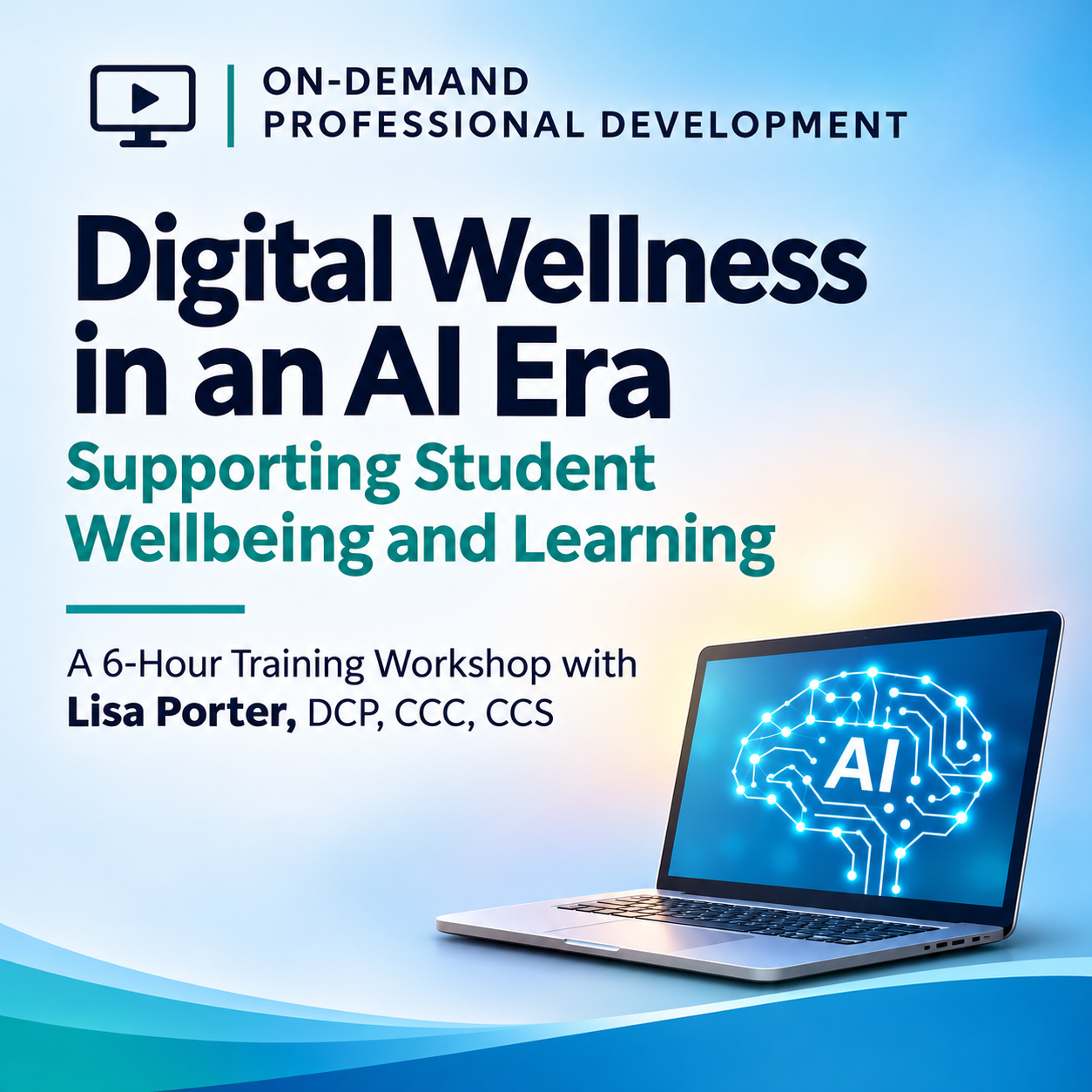
Digital Wellness in an AI Era: Practical Strategies for Educators and Clinicians
Presented by Lisa Porter, DCP, CCC, CCS
Format: On-Demand Online Learning
Workshop Overview
Children, adolescents, and adults are navigating a world increasingly shaped by social media, smartphones, artificial intelligence, and constant digital connectivity. These technologies are influencing how people learn, communicate, form relationships, seek support, and experience mental health challenges. Educators and clinicians are often left wondering how to respond effectively while supporting wellbeing in a rapidly changing environment.
This practical workshop provides evidence-informed strategies for promoting digital wellness in schools, counselling settings, healthcare environments, and community programs. Participants will explore the relationship between technology use and mental health, including anxiety, depression, social comparison, sleep disruption, attention difficulties, cyberbullying, fear of missing out (FoMO), emotional regulation, and social connection.
Drawing on research and real-world examples, Lisa Porter examines how artificial intelligence and digital technologies are changing learning, help-seeking behaviours, and interpersonal relationships. The workshop offers practical approaches to healthy technology habits, resilience, critical thinking, and responsible engagement with online spaces.
Emerging topics include AI companionship, academic integrity in the age of generative AI, privacy, and ethical considerations in educational and clinical settings. Rather than focusing only on restricting technology use, participants will explore constructive ways to engage with digital tools while protecting the human connection essential to learning, development, and therapeutic change.
What You’ll Explore
- How smartphones, social media, and artificial intelligence affect learning, relationships, and mental health.
- Digital wellbeing concerns including anxiety, attention, sleep, social comparison, FoMO, and cyberbullying.
- Strategies for building resilience, self-regulation, and healthy technology habits.
- Digital citizenship, critical thinking, and responsible online behaviour.
- AI companionship and changing online help-seeking behaviours.
- Privacy, academic integrity, and ethical uses of AI in education and clinical practice.
- Ways to preserve meaningful human connection in an increasingly digital world.
Learning Objectives
By the end of this workshop, participants will be able to:
- Describe how artificial intelligence, social media, smartphones, and digital technologies influence learning, communication, relationships, and mental health.
- Examine evidence regarding technology use and wellbeing, including factors that contribute to risk and resilience.
- Apply practical strategies that promote healthy technology habits, digital citizenship, and digital wellness.
- Evaluate issues involving AI, digital ethics, privacy, academic integrity, and online help-seeking.
- Develop approaches for supporting healthy, balanced, and responsible technology engagement among children, adolescents, and adults.
Workshop Topics
- Understanding Today’s Digital World: The influence of constant connectivity on learning and wellbeing.
- Technology and Mental Health: Research on mood, attention, sleep, emotional regulation, and digital dependency.
- Risks and Protective Factors: Recognizing concerns while building resilience.
- Healthy Digital Habits: Supporting balanced, intentional technology use.
- Digital Citizenship and AI: Critical thinking, online information, and digital relationships.
- Families, Schools, and Clinical Practice: Responding to AI companionship, online help-seeking, and self-regulation needs.
- Ethical Technology Use: Privacy, safety, academic integrity, and responsible AI applications.
- Human Connection and Action Planning: Translating workshop insights into practical next steps.
What’s Included With Your Registration
- Access to the on-demand workshop recording.
- Downloadable presentation handouts.
- Certificate of completion upon completing the required lessons and quiz.
- 6 hours of professional learning.
Access deadline: Access is available through February 1, 2027. Course videos, handouts, and completion requirements must be finished before access expires. Extensions are not available.
Continuing education: Please confirm any specific continuing education or professional regulatory requirements with your applicable organization.
Who Should Attend?
This workshop is designed for educators, school counsellors, psychologists, clinical counsellors, social workers, family therapists, youth workers, school administrators, educational assistants, healthcare professionals, and others who support children, adolescents, and adults in educational, mental health, or community settings.
About the Presenter
Lisa Porter, DCP, CCC, CCS, began her career as a high school teacher in Alberta and British Columbia before transitioning to high school counselling, where she spent ten years supporting student mental health and wellbeing. After completing her doctoral degree in Counselling and Psychotherapy, she moved into higher education and now teaches in Master of Education and Master of Counselling programs.
Her research and professional presentations focus on social media, artificial intelligence, and digital technologies in mental health, education, and professional practice. Lisa emphasizes practical, evidence-informed responses to emerging technologies and is co-author and co-editor of School Counselling in Canada: A Comprehensive Guide (2025).