
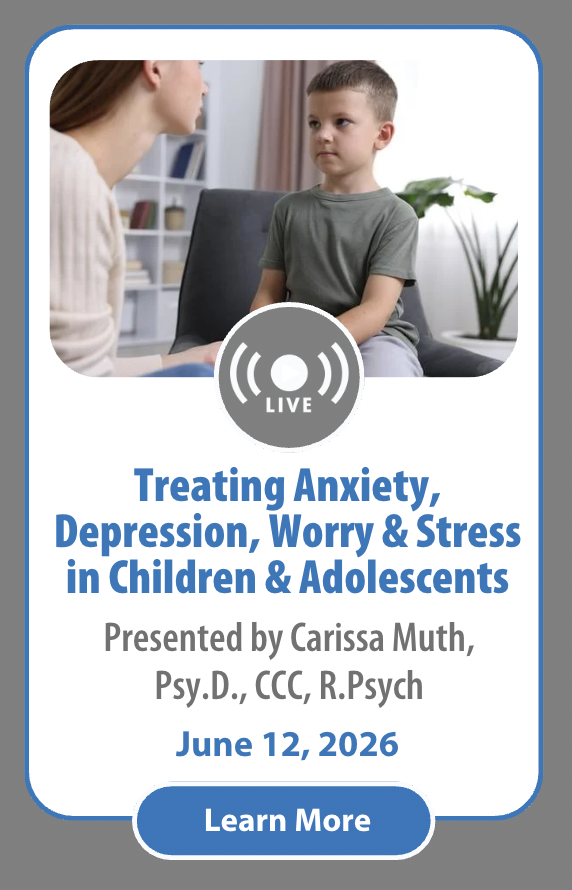
Treating Anxiety, Depression, Worry and Stress in Children and Adolescents

Presented by Carissa Muth, Psy.D., CCC, R.Psych

Live Streaming June 12, 2026

$229.00

6 Hours  |   Pre-approved for CEU’s

!

Attend Both Days and Save! Promo Code: MUTH2DAY

somdn_product_page

Description

LIVE STREAM: June 12, 2026 from  8:30am – 4:00pm (Whitehorse, YT) Please adjust your start time according to your specific time zone. 

ON-DEMAND: Recorded footage & course content (certificate, videos, quiz) will be available until July 21, 2026. Please allow 3 – 5 business days for footage to be processed. Extensions cannot be granted under any circumstances.


Day One of a Two-Day Training | Attend Both Days and Save! Promo Code: MUTH2DAY

Day One focuses on the integrative treatment of adult trauma, addiction, and complex comorbidities, drawing from neuropsychology, DBT, CBT, Narrative Therapy, and Meaning-Focused interventions.

Day Two addresses anxiety, depression, worry, and stress in children and adolescents, emphasizing developmentally appropriate CBT- and ACT-based strategies, family systems work, and creative interventions.

Participants may attend either day independently or both days together.


Day Two: In this comprehensive training, Dr. Carissa Muth addresses the escalating crisis of internalizing disorders in youth, providing clinicians with a robust framework for treating anxiety, depression, and chronic stress. Moving beyond standard “talk therapy,” the course adapts evidence-based protocols—specifically Cognitive Behavioral Therapy (CBT) and Acceptance and Commitment Therapy (ACT)—to match the developmental needs of children and teenagers. Participants will learn to distinguish between normal developmental fears and clinical diagnoses, avoiding the common trap of pathologizing growing pains while ensuring acute distress is not overlooked. Dr. Muth places special emphasis on the “family system,” teaching therapists how to coach parents out of “accommodation behaviors” that inadvertently feed a child’s anxiety. The workshop also covers practical strategies for addressing the unique presentation of childhood depression, which often masks as irritability or somatic complaints rather than sadness. Finally, attendees will leave with a toolkit of creative, play-based, and somatic interventions to engage resistant youth and build lifelong resilience.
Module 1: The Anxious & Depressed Brain – Developmental Context

  • The “Hidden” Epidemic: Understanding current trends in youth mental health (social media impact, post-pandemic stressors).
  • Assessment & Diagnosis:
    • Depression vs. Irritability: Why depressed kids often look angry, not sad.
    • Anxiety vs. ADHD: Teasing apart restlessness from worry.
  • Neurobiology for Kids: How to explain the “Amygdala Alarm” to a 7-year-old vs. a 15-year-old.

Module 2: Anxiety & Worry – The CBT & ACT Toolkit

  • Externalization: Naming the Anxiety (e.g., ” The Bully,” “The Worry Bug”) to separate the child from the symptom.
  • The Avoidance Trap: Teaching kids (and parents) that avoidance feeds the fear.
  • Cognitive Defusion: ACT techniques for teens to “unhook” from spiraling thoughts rather than fighting them.
  • Exposure “Missions”: Designing playful, gamified exposure hierarchies to face fears gradually.

Module 3: The Parent Trap – Systemic Interventions

  • Understanding Accommodation: The well-intentioned things parents do that keep anxiety alive (e.g., ordering for the child, sleeping in their bed).
  • The SPACE Model Concepts: Brief introduction to Supportive Parenting for Anxious Childhood Emotions.
  • Co-Regulation: Teaching parents to be the “thermostat” rather than the “thermometer” of the emotional climate.

Module 4: Depression – Breaking the Inertia

  • Behavioral Activation (BA):
    • The Fun First Rule: Why we schedule enjoyment before mastery for depressed teens.
    • Activity Monitoring: Tracking mood vs. activity to prove the link to the client.
  •  Suicide & Self-Harm Assessment: Specific protocols for assessing risk in minors and safety planning with parents.
  • Somatic Complaints: Addressing the “stomach ache” of depression without medicalizing emotional pain

Module 5: Stress Management & Resilience

  • School Refusal: A specific protocol for getting kids back into the classroom.
  • Sleep Hygiene: The critical role of sleep in emotional regulation for adolescents.
  • Social Media Literacy: Helping teens navigate the “comparison trap” and cyber-stress.

Module 6: Integration & Case Studies

  • The Comorbid Child: Managing a case with both high anxiety and depressive shut-down.
  • Engaging the Resistant Teen: Strategies for the client who “doesn’t want to be here.”
  • Q&A
  • Differentiate between developmentally appropriate worry (e.g., stranger anxiety, academic stress) and clinical disorders to ensure accurate diagnosis and treatment planning.
  • Apply youth-friendly CBT interventions, such as “externalizing the worry monster” and “thought detective” exercises, to help children challenge maladaptive thinking patterns.
  • Identify and address “Family Accommodation Behaviors”—where parents modify routines to prevent a child’s distress—that maintain and worsen anxiety disorders.
  • Utilize Behavioral Activation strategies adapted for adolescents to break the cycle of withdrawal and lethargy common in youth depression.
  • Teach somatic regulation skills that help children manage physical symptoms of stress (stomach aches, headaches) when they lack the vocabulary to express emotion.
Education and Clinical Professionals: K–12 Classroom Teachers, School Counsellors/Psychologists, Learning Assistance/ Resource Teachers, School Administrators, School Paraprofessionals including Special Education Assistants, Classroom Assistants and Childcare Workers. All other professionals who support students including but not limited to: Nurses, Social Workers, Psychologists, Clinical Counsellors, Family Therapists, Occupational Therapists, Speech Language Pathologists, Addiction Counsellors, Youth Workers, Mental Health Workers, Probation Officers, and Early Childhood Educators.

Dr. Carissa Muth is a registered psychologist in Alberta and British Columbia and the Clinical Director at the Sunshine Coast Health Centre and Georgia Strait Women’s Clinic.  She holds Doctorate of Psychology, Master of Arts in Counselling, and Bachelor of Social Work degrees and ran a private practice in Alberta for the last ten years. With over fifteen years of experiences in the mental health field, Dr. Muth has provided psychological assessments, therapeutic treatments and conducted research in the field of substance addictions and co-morbid psychological disorders. With both a passion for learning and teaching, Dr. Muth has presented her research and expertise across the country at a variety of mental health conferences.

RegistrationEarly bird FeeRegular Fee
Individual Enrollment$229.00N/A
Group 3 - 7$169.00N/A
Group 8 - 15$119.00N/A
Group 15+ $99.00N/A
Full-Time Student$99.00N/A

All fees are in Canadian dollars ($CAD) and per person.

How to Purchase a Group Rate

  1. Add Seats to Your Cart
    Select the total number of seats you need for your group and add them to your cart. Each seat represents one participant who will be enrolled in the course.

  2. Complete Your Purchase
    Proceed to checkout and complete the payment for the total number of seats needed for your group.

  3. Contact Our Office
    Once your purchase is complete, please contact our office at webinars@jackhirose.com with your order number.

  4. Receive Group Enrollment Link
    We will send you a unique link that you can distribute to group members. Group members will be required to use this link to complete receiving access to the course.

If you have any questions or need assistance, don’t hesitate to reach out.

Fees are per person, seat sharing is not allowed. Please respect this policy, failure to comply will result in termination of access without a refund. For group rates please contact webinars@jackhirose.com

  • Canadian Psychological Association
    The Alberta College of Social Workers (ACSW) and the Newfoundland and Labrador Association of Social Workers (NLASW) accept CPA-approved continuing education credits