Description
LIVE STREAM: February 11, 2026 from 8:30am – 4:00pm (Vancouver, BC) Please adjust your start time according to your specific time zone.
ON-DEMAND: Recorded footage & course content (certificate, videos, quiz) will be available until March 16, 2026. Please allow 1- 3 business days for footage to be processed. Extensions cannot be granted under any circumstances.
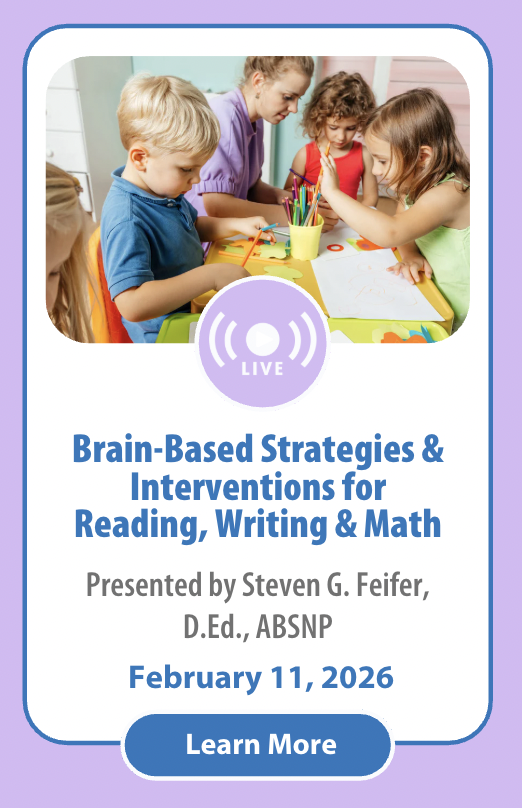
This training provides a comprehensive, brain-based overview of how children develop core academic skills in mathematics, reading, and written expression. Drawing on current neuropsychological research, the workshop emphasizes practical, evidence-based strategies that educators and clinicians can use to support learners with diverse needs.
Participants will explore how young children acquire fundamental mathematical skills, including the three primary numerical processing systems in the brain and the essential role of language in building conceptually organized number sets. Key cognitive processes—such as working memory, visual-spatial reasoning, and executive functioning—will be discussed as core contributors to number sense, along with the impact of anxiety, cultural differences, and teaching style. The session will also include a brief review of the Feifer Assessment of Mathematics (FAM) and its applications.
The course examines reading and written language disorders from a brain-based educational perspective, highlighting how phonemic awareness, phonological and orthographic processing, working memory, and executive functioning shape literacy development. Participants will learn how to differentiate dyslexia from other reading disorders and review four distinct subtypes of developmental reading challenges, paired with evidence-based intervention strategies. An introduction to the Feifer Assessment of Reading (FAR) will also be provided.
Written expression will be explored through current learning trends in Canada, gender differences in writing achievement, and the influence of “frontal lobe” processes—including attention, working memory, and executive functioning—on writing performance. Three primary subtypes of writing disorders will be outlined, along with five essential steps for effective writing instruction and key intervention strategies. The Feifer Assessment of Writing (FAW) and additional diagnostic tools will be reviewed to support accurate identification of written language disorders, including dysgraphia.
By the end of this training, attendees will gain a deeper understanding of the neuropsychological foundations of learning and leave with actionable tools to assess, identify, and support students struggling with mathematics, reading, and writing.
8:30am – 10:00am * Literacy rates in Canada
* Defining developmental dyslexia
* Four universal truths of reading
* Establishing the main neurodevelopmental pathways for reading
10:00-10:15 *BREAK*
10:15-12:00 * Four subtypes of reading disorders
* Interventions for dyslexia subtypes
* Introduction to the Feifer Assessment of Reading (FAR)
12:00-1:00pm *LUNCH*
1:00 – 2:30 * Prevalence of written language disabilities
* Why do boys struggle more than girls with written language?
* Eight core cognitive constructs underscoring written language
2:30-2:45 *BREAK*
2:45-3:45 * Three subtypes of written language disorders
* Five essential components to develop written language proficiency
* An introduction to the Feifer Assessment of Writing (FAW)
3:45-4:00 * Questions
Education and Clinical Professionals: All education and mental health or healthcare professionals who work with children or youth including, but not limited to K–12 Classroom Teachers, School Counsellors, Learning Assistance/Resource Teachers, School Administrators, School Paraprofessionals including Special Education Assistants, Classroom Assistants and Childcare Workers • All other professionals who support behavioural challenges and complex learning needs including but not limited to: Nurses, Social Workers, Psychologists, Clinical Counsellors, Family Therapists, Occupational Therapists, Speech Language Pathologists, Addiction Counsellors, Youth Workers, Mental Health Workers, Probation Officers and Community Police Officers.
Steven G. Feifer, D. Ed., NCSP, ABSNP is an internationally renowned speaker and author in the field of learning disabilities, and has authored eight books on learning and emotional disorders in children. He has more than 20 years of experience as a school psychologist, and is dually certified in school neuropsychology. Dr. Feifer was voted the Maryland School Psychologist of the Year in 2008, and awarded the 2009 National School Psychologist of the Year. He was the recipient of the 2018 Outstanding Contribution to the Education and Training of Psychologists award by the Maryland Psychological Association. Dr. Feifer serves as a consultant to a variety of school districts, and is a popular presenter at state and national conferences. He has authored three tests on diagnosing learning disabilities in children, all of which are published by PAR.
| Registration | Early bird Fee | Regular Fee |
|---|
| Individual Enrollment | $229.00 | N/A |
| Group 3 - 7 | $169.00 | N/A |
| Group 8 - 15 | $119.00 | N/A |
| Group 15+ | $99.00 | N/A |
| Full-Time Student | $99.00 | N/A |
All fees are in Canadian dollars ($CAD) and per person.
How to Purchase a Group Rate
-
Add Seats to Your Cart
Select the total number of seats you need for your group and add them to your cart. Each seat represents one participant who will be enrolled in the course.
-
Complete Your Purchase
Proceed to checkout and complete the payment for the total number of seats needed for your group.
-
Contact Our Office
Once your purchase is complete, please contact our office at webinars@jackhirose.com with your order number.
-
Receive Group Enrollment Link
We will send you a unique link that you can distribute to group members. Group members will be required to use this link to complete receiving access to the course.
If you have any questions or need assistance, don’t hesitate to reach out.
Fees are per person, seat sharing is not allowed. Please respect this policy, failure to comply will result in termination of access without a refund. For group rates please contact webinars@jackhirose.com