Description
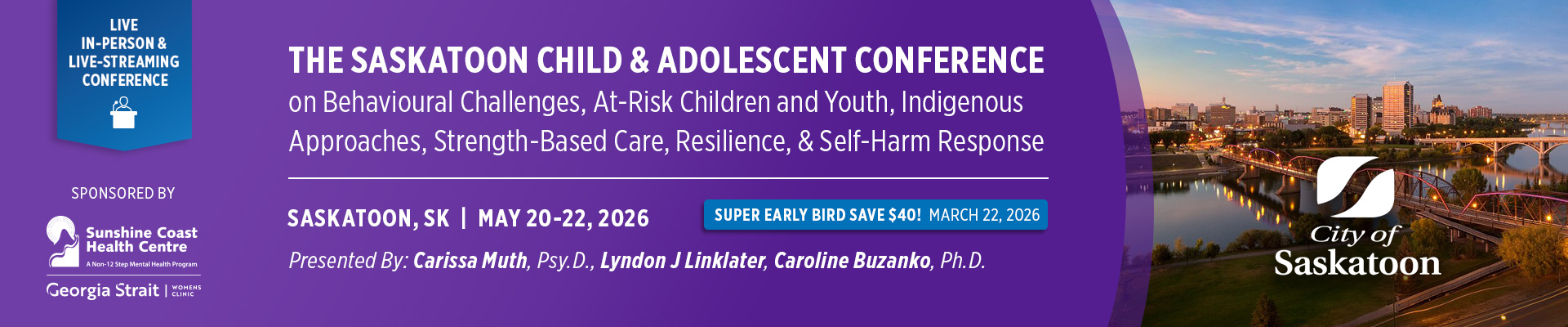
LIVE STREAM: May 20, 2026 from 8:30am – 4:00pm (Saskatoon, SK) Please adjust your start time according to your specific time zone.
ON-DEMAND: Recorded footage & course content (certificate, videos, quiz) will be available until June 29, 2026. Please allow 3 – 10 business days for footage to be processed. Extensions cannot be granted under any circumstances.
May 20, 2026 | Day One

Working with High Risk Children and Adolescents: Collaborative and Strength-Based Interventions
This workshop provides participant with advanced frameworks for effectively treating children and adolescents who present with high-risk behaviours and complex emotional dysregulation. Moving beyond traditional compliance-based models, the training emphasizes collaborative, strength-based interventions that empower young clients and enlist families as active partners in the healing process. Participants will explore the neurobiology of “challenging” behaviour, reframing explosive outbursts and opposition as adaptive responses to unmet needs or skill deficits.
The session offers a deep dive into practical risk assessment and safety planning, ensuring youth and child professionals can manage acute crises such as self-harm, aggression, and suicidality with confidence. Dr. Muth will demonstrate how to integrate evidence-based approaches—including Collaborative & Proactive Solutions (CPS), Motivational Interviewing, and Solution-Focused Brief Therapy—to resolve chronic problems and reduce therapeutic resistance. Finally, the workshop equips attendees with tools to build cross-sector teams, bridging the gap between therapy, school, and home environments to create a unified safety net for at-risk youth.
Module 1: Paradigm Shift – Understanding the “Why”
- The Myth of Motivation: Dr. Muth debunks the idea that “kids do well if they want to” and explores the philosophy of “kids do well if they can.”
- The Neurobiology of “Bad” Behavior:
- The role of the amygdala and prefrontal cortex in dysregulation.
- Fight/Flight/Freeze responses in clinical settings.
- Strength-Based Profiling: Moving beyond diagnostic labels to map the child’s assets, resilience factors, and “islands of competence.”
Module 2: Risk Assessment & Crisis Management
- Triage and Assessment:
- Differentiating between suicidal ideation, non-suicidal self-injury (NSSI), and aggression/conduct issues.
- Assessing lethality, intent, and access to means.
- Safety Planning 2.0: Moving beyond the “contract for safety.” Creating dynamic plans that include specific coping skills, identified support people, and environmental restrictions.
- Legal & Ethical Considerations: When to breach confidentiality, duty to report, and navigating consent with minors.
Module 3: The Collaborative Toolkit – Integrated Interventions
- Collaborative & Proactive Solutions (CPS):
- Dr. Muth reviews the “Plan B” conversation structure to solve problems collaboratively rather than unilaterally.
- Motivational Interviewing (MI) for Adolescents:
- “Rolling with Resistance”: How to sidestep power struggles when a client is defensive.
- Using “Change Talk” to increase intrinsic motivation for safety.
- Solution-Focused Techniques:
- The Miracle Question and Exception Finding: Identifying times when the problem isn’t happening to build on success.
- Narrative Approaches:
- Externalizing the problem (e.g., “fighting The Rage” vs. “being an angry kid”) to reduce shame and defensiveness.
Module 4: Engaging the System – Families and Schools
- Parent Coaching with PACE:
- Using Dr. Dan Hughes’ Playfulness, Acceptance, Curiosity, and Empathy (PACE) model to help parents co-regulate rather than police behavior.
- Addressing Caregiver Burnout: Validating the exhaustion of raising a high-needs child while teaching parents to manage their own triggers.
Module 5: Advanced Case Application & Synthesis
- Complex Case Studies: Reviewing real-world scenarios presented by Dr. Muth involving dual diagnoses (e.g., ASD + Trauma, ADHD + ODD).
- Selecting the Right Tool: Discussing when to use CPS vs. MI vs. rigid safety protocols based on the client’s current state of regulation.
- Troubleshooting: “What if the child refuses to talk?” Strategies for non-verbal engagement and building safety without words.
Module 6: Closing & Sustainability
- Review of Key Concepts: Rapid recap of the integrated toolkit.
- Self-Care for the Therapist: Managing countertransference and vicarious trauma when working with aggression and high-stakes risk.
- Q&A
Education and Clinical Professionals: K–12 Classroom Teachers, School Counsellors/Psychologists, Learning Assistance/ Resource Teachers, School Administrators, School Paraprofessionals including Special Education Assistants, Classroom Assistants and Childcare Workers. All other professionals who support students including but not limited to: Nurses, Social Workers, Psychologists, Clinical Counsellors, Family Therapists, Occupational Therapists, Speech Language Pathologists, Addiction Counsellors, Youth Workers, Mental Health Workers, Probation Officers, and Early Childhood Educators.
| Registration | Early bird Fee | Regular Fee |
|---|
| Individual 1 Day Enrollment | $229.00 | N/A |
| 1 Day Group 3 - 7 | $169.00 | N/A |
| 1 Day Group 8 - 15 | $119.00 | N/A |
| 1 Day Group 15+ | $99.00 | N/A |
| | |
| Individual 2 Day Enrollment | $399.00 | N/A |
| 2 Day Group 3 - 7 | $295.00 | N/A |
| 2 Day Group 8 - 15 | $208.00 | N/A |
| 2 Day Group 15+ | $173.00 | N/A |
| | |
| Individual 3 Day Enrollment | $569.00 | N/A |
| 3 Day Group 3 - 7 | $420.00 | N/A |
| 3 Day Group 8 - 15 | $296.00 | N/A |
| 3 Day Group 15+ | $246.00 | N/A |
All fees are in Canadian dollars ($CAD) and per person.
How to Purchase a Group Rate
-
Add Seats to Your Cart
Select the total number of seats you need for your group and add them to your cart. Each seat represents one participant who will be enrolled in the course.
-
Complete Your Purchase
Proceed to checkout and complete the payment for the total number of seats needed for your group.
-
Contact Our Office
Once your purchase is complete, please contact our office at webinars@jackhirose.com with your order number.
-
Receive Group Enrollment Link
We will send you a unique link that you can distribute to group members. Group members will be required to use this link to complete receiving access to the course.
If you have any questions or need assistance, don’t hesitate to reach out.
Fees are per person, seat sharing is not allowed. Please respect this policy, failure to comply will result in termination of access without a refund. For group rates please contact webinars@jackhirose.com