


Description
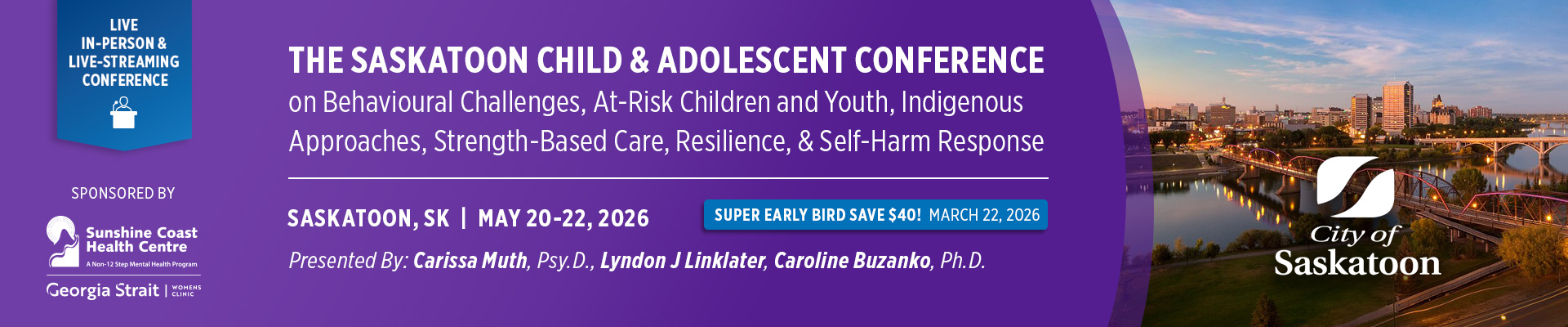
LIVE STREAM: May 20 – 22, 2026 from 8:30am – 4:00pm (Saskatoon, SK) Please adjust your start time according to your specific time zone.
ON-DEMAND: Recorded footage & course content (certificate, videos, quiz) will be available until June 29, 2026. Please allow 3 – 10 business days for footage to be processed. Extensions cannot be granted under any circumstances.
May 20, 2026 | Day One

Working with High Risk Children and Adolescents: Collaborative and Strength-Based Interventions
Presented by Carissa Muth, Psy.D., CCC, R.Psych
This workshop provides participant with advanced frameworks for effectively treating children and adolescents who present with high-risk behaviours and complex emotional dysregulation. Moving beyond traditional compliance-based models, the training emphasizes collaborative, strength-based interventions that empower young clients and enlist families as active partners in the healing process. Participants will explore the neurobiology of “challenging” behaviour, reframing explosive outbursts and opposition as adaptive responses to unmet needs or skill deficits.
The session offers a deep dive into practical risk assessment and safety planning, ensuring youth and child professionals can manage acute crises such as self-harm, aggression, and suicidality with confidence. Dr. Muth will demonstrate how to integrate evidence-based approaches—including Collaborative & Proactive Solutions (CPS), Motivational Interviewing, and Solution-Focused Brief Therapy—to resolve chronic problems and reduce therapeutic resistance. Finally, the workshop equips attendees with tools to build cross-sector teams, bridging the gap between therapy, school, and home environments to create a unified safety net for at-risk youth.
May 21, 2026 | Day Two

Applying Indigenous Practices to Build Resilience and Strength in Children and Adolescents
Presented by Lyndon J. Linklater, BISW
In this transformative full-day workshop, Lyndon Linklater draws on Indigenous worldviews, cultural teachings, and over two decades of experience to illuminate how resilience is nurtured through identity, land, language, and community. Lyndon will guide participants in exploring the historical and contemporary significance of Treaties. This perspective will help attendees deepen their awareness of shared responsibilities and how Treaties influence educational, clinical, and community-based work today.
Participants will explore how children and adolescents carry not only inherited trauma, but also deep inherited strength—rooted in cultural continuity, kinship, and ancestral teachings. Through powerful storytelling, reflection, and practical guidance, Lyndon will support educators, clinicians, and community professionals in fostering environments where Indigenous young people feel valued, grounded, and connected.
May 22, 2026 | Day Three

Working with Children and Youth Who are High-Risk, Marginalized and Engage in Self-Harming
Presented by Caroline Buzanko, Ph.D., R. Psych
For anyone who know that “safety contracts” don’t work and want to know what does. Self-harm among youth isn’t rising because young people are more fragile. It’s rising because the conditions they’re navigating create psychological states where harming one’s own body makes functional sense. This intensive 6-hour workshop is designed for anyone who work with the youth carrying the heaviest burdens: those at the intersection of marginalization, trauma, and self-injury.
You’ll move beyond risk management checklists to understand the why beneath the behaviour. Drawing on the established theories and evidence-based interventions for self-harm, this training provides the clinical precision needed when the stakes are highest.
This workshop addresses the reality that therapy fails when it replicates the same power dynamics that harm youth in the first place. You’ll learn how to structure engagement that honours adolescent autonomy, conduct chain analyses that reveal intervention points invisible in standard assessments, and teach physiological regulation skills that work when cognitive strategies fail. We’ll tackle the specific dialectical dilemmas of adolescent treatment: how to involve parents without breaking confidentiality, how to validate pain without reinforcing dysfunction, and how to adapt evidence-based protocols for youth who experience standard therapeutic language as minimizing and unhelpful.
You’ll also confront the parts of this work that textbooks skip: how to stay regulated when a 14-year-old shows you fresh burns, how to respond when a family’s exhaustion manifests as rage, and how to maintain therapeutic boundaries while practicing the “moral courage” required to witness historical trauma.
This workshop is key to develop enough technical skill and relational capacity that young people choose to stay alive long enough to discover they want to.